
Waukesha County Property Value Types
The label "property value" covers several distinct figures. Waukesha County Tax Listing links out to assessment information. Each city, town, or village performs its own valuation work. A recorded transfer documents a sale event. The tax bill lists the charges that followed. Check the custodian listed for each record type. Then read the field label on the parcel itself before treating a number as market value.
| Value | What It Is | Where |
|---|---|---|
| Assessed value | Local value recorded for property-tax purposes. | Municipal assessor; county Tax Listing links. |
| Market value estimate | A sale-oriented estimate; do not assume the parcel card labels one. | Ask the local assessor or a licensed appraiser. |
| Recorded sale evidence | A conveyance and any price information available from transfer material. | Register of Deeds and Real Estate Transfer Return record. |
| Tax amount | Charges and payments, not an estimate of sale value. | County Treasurer bill. |
An assessed figure exists for taxation. It is not an appraisal. A Waukesha County parcel may fetch a different price on the open market. The county publishes no current assessment ratio to apply to a single tax card. So no ratio should be inferred from one. A licensed appraiser is the right professional for a market-value opinion. That opinion is tied to a specific purpose.
Municipal Assessment in Waukesha County
County Tax Listing keeps parcel information current and coordinates tax data across jurisdictions. The valuation detail lives in each municipality. A Waukesha parcel and a New Berlin parcel sit in the same county portal. Yet each has its own local assessment contact for parcel and tax questions. Start with the parcel's municipality before requesting a value detail or a correction. That step saves time and reaches the office that actually set the figure.
The county publishes no single countywide reassessment calendar and no complete list of assessment fields. Ask the local assessor for the year shown. Ask for the property characteristics used and any public data behind the number.
Waukesha County Sale Price Records
A recorded deed proves that a conveyance happened. But the tax roll is not a sale-price database. Transfer details in Waukesha County may attach to the deed itself. They may also attach to the Wisconsin Real Estate Transfer Return receipt. Not every deed in the remote portal displays a price. Never back into a sale price from assessed value, a tax amount, or a neighboring parcel. Each of those numbers was built for a different purpose.
Search the Register of Deeds using the legal description. Then open any transfer material tied to the instrument. A price from an older deed records a historical fact. It is not a current market appraisal.
Waukesha County Value Dates and Comparisons
Every value needs a date and a source. A tax-year assessment can diverge sharply from a recent sale. The figures serve different purposes and update on different schedules. Waukesha County municipalities run their own reassessment cycles. Compare the year printed on the record rather than applying any countywide assumption or ratio.
To compare two parcels, first match municipality, property type, legal description, and assessment year. Then find the recorded sale event and the local assessment record for each. A number without a source date cannot explain a change in property value.
Finding a Waukesha County Property Value
Open the county record with a parcel address or Tax Key, then confirm which municipal assessor supplied the assessment detail. The tax bill is a separate Treasurer record. For a transaction value, use the recorded deed and its transfer material rather than assuming the tax record carries a last-sale field.
- Find the parcel in Waukesha County Tax Listing by address or Tax Key.
- Note the municipality and assessment year shown on the linked record.
- Ask the local assessor which value field and property data apply.
- Search the deed and transfer material for a recorded sale event.
- Assessed value
- A municipal assessment figure used in property-tax administration.
- Market value
- An estimate of likely exchange price under a stated method and date.
- Sale price
- Price tied to a transfer record when the information is available.
- Assessment ratio
- A comparison of assessed and market values; the local current ratio was not verified in the research.
Waukesha County Tax Listing Value Links
The Waukesha County Tax Listing portal is the entry point for a parcel and its assessment links. A result may lead to tax information or to the local assessor's record. Read the date and the field labels on the official page before comparing Waukesha County values across years, since labels can shift between record types.
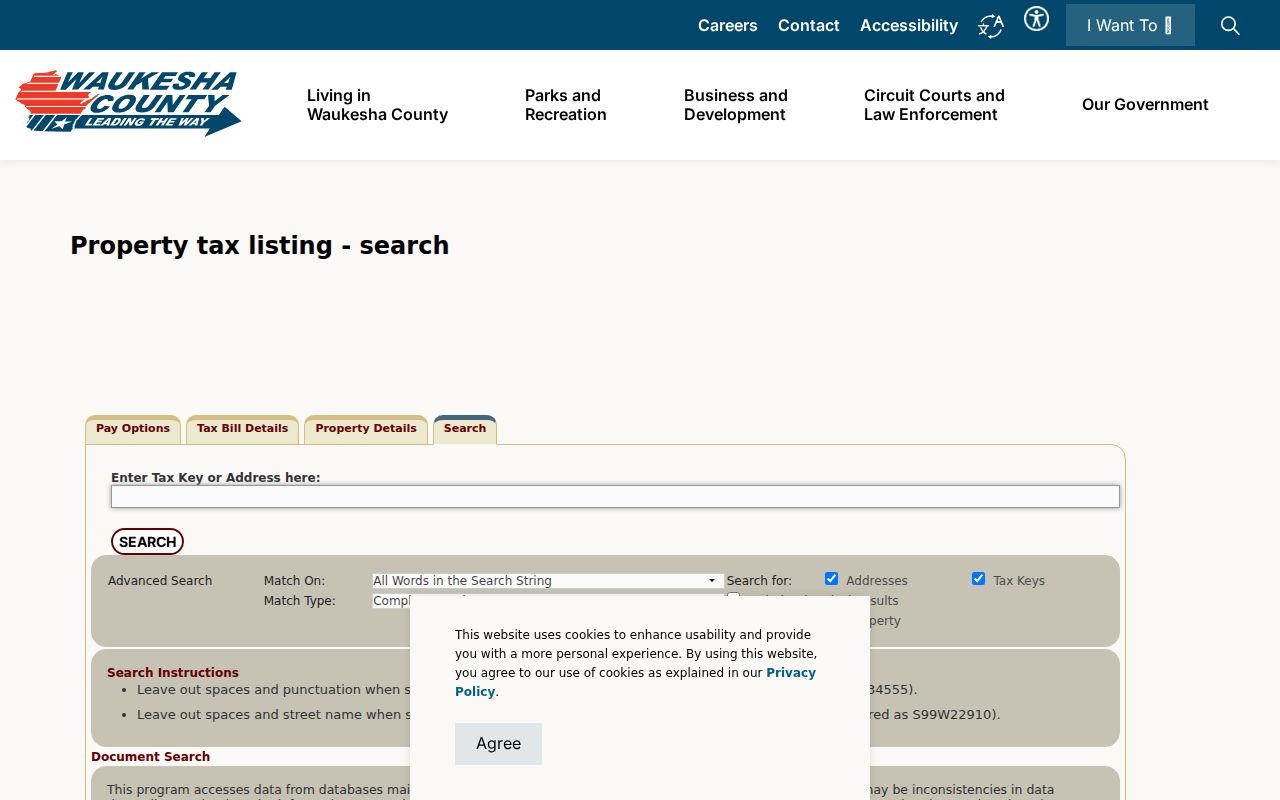
Use the linked assessment for the tax figure. The Treasurer's bill covers charges and payment status.
Waukesha County Tax Treatment and Exemptions
A credit or exemption changes tax treatment without touching a property's recorded sale price. A homestead or lottery-credit flag on a Waukesha County record can be a useful clue. Field names and eligibility rules vary locally. Ask the municipal assessor or Treasurer what a flag means for the parcel and tax year in question.
The tax bill itself explains charges and payments. The Waukesha County property tax records page separates billing, assessment, and local review.
What Waukesha County Assessed Value Is Not
An assessed value is a tax figure built from local assessment work. It is not a price a buyer will pay, a guarantee of what a parcel could sell for, or a substitute for a licensed appraisal. It can differ from a recent sale simply because the dates and the methods differ.
Value versus price. A Waukesha County assessed value is used for taxation, not as a promise of sale price. A licensed appraiser can provide a market opinion for a stated date and purpose.
How Waukesha Assessment and Tax Data Fit Together
Waukesha County handles the big picture through its Tax Listing. It keeps taxable and exempt parcel lists, property descriptions, and county tax-data links. It also prepares tax bills for 34 municipalities. The fine-grained work stays local. Each city, town, or village in Waukesha County does its own assessing. So a county parcel result is a starting place rather than the final word on any single property. Questions about assessed characteristics, a local review process, or an assessment notice belong with the municipality. That is the office that values the parcel.
Assessed value, taxable value, and the amount due on a bill are three different things. Assessment records feed the local property-tax system. Credits and exemptions can change the tax treatment. The bill reflects taxes plus charges for a given year. Waukesha County publishes no single countywide assessment ratio, appeal calendar, or revaluation schedule. It also publishes no city-specific 2024 trend. Confirm the applicable year and local process with the assessor before comparing figures.
Comparing Waukesha Property Values by Record Date
Comparing values takes records from matching dates. Keep the Tax Key, legal description, municipality, and tax year beside every assessment you review. A recorded deed documents a conveyance and its legal parties. A tax bill shows the amount due and its payment status. Neither one is an appraisal or a market analysis.
Parcel traits and timing matter too. Waukesha's older urban lots, post-1940 curving subdivisions, and newer annexation or CSM areas all shape the record. These areas carry different lot patterns and assessment histories. A parcel split can shift which land sits under a Tax Key. Match the legal description first. Then compare the assessment year and any recorded transfer. Do not infer value from a neighborhood name or a population trend.
Waukesha Tax Credits Are Not Market Evidence
A homestead or lottery-credit indicator signals a tax treatment or an owner-occupancy claim. It proves no legal title. Nor does it prove residence or sale value. Ask the Treasurer about bill and payment records. Ask the municipal assessor about assessment entries. Use recorded conveyance documents for transaction history.
A higher tax bill does not mean market value rose by the same percentage. Levies, credits, exemptions, and the tax year all shape the amount due. Keep the bill, assessment, and deed in separate parts of a value comparison. Cite which record supports each figure. If the question is what a buyer might pay today, seek qualified valuation advice rather than treating county reference pages as an appraisal.